Nubian influences on construction and design
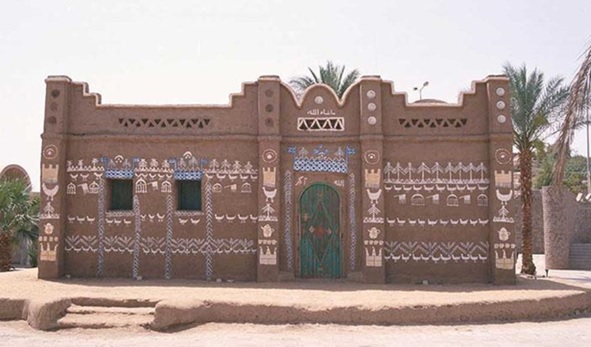
What is a Nubian house? A Nubian house is a unique way of building that the people of Nubia ( south Egypt) used to build their homes. Although it’s made of mud bricks and palm trees’ trunks it has excellent heat and acoustic insulation qualities utilizing material from the environment and using vaulted-shape ceiling. Where is Nubia? Geographically, Nubia of Egypt extended along the river Nile from the 1st cataract north to Egypt-Sudan’s borders south. Between latitude 22 & 24 North. This vital location played a great role for Nubians throughout history as merchants and guardians of the trade route between North and tropical Africa. Nubians lived in villages on both banks of the Nile, surrounded by arid desert; they farmed their land adjacent to the Nile. The Nile ( or el Bahar) as the Nubians call it, was central to life in Nubia, merely its existence was a source of psychological comfort to them, even the story of the Nile creation was told by mothers to their children. “Elizabeth Fernea, who traveled in Nubia before the displacement, documented the story in her book “A View of the Nile”. She wrote: “Once upon a time, a great and good prince was beset by evil enemies. He had no recourse but to try to escape, and so, taking his sword, he fled north from caves and rocks deep in Africa. He began to run very fast, trilling his sword behind him. He turned this way and that, to avoid his enemies who were close behind him, and wherever he ran, wherever his sword touched the ground, the earth opened, and a silver river flowed to protect him. When he reached the Mediterranean Sea, he disappeared. Many people have waited for the return of the good prince, but he has never been seen again. The river still remains. It is the Nile”. Fernea, Elizabeth, A View of the Nile, Doubleday & Co. Press, Garden City, New York, 1970, p.255. Utilizing the environment The hot climate and the Nile made old Nubia a perfect place to grow palm trees. The famous palm trees of Nubia were not only a source of good-quality dates, but also a source of almost everything that Nubians made, they used its dried leaves to make baskets and beds, used its trunks as columns, used leaves, and also for roofing. They used palm trees for shading and cooling in their villages’ landscapes. Nubian homes There is no doubt that many observers who visited old Nubia, before the displacement, admired Nubian dwellings, with their unique way of building, However, that physical house was not a product of one individual; it was indeed a representation of collective creativity. In his dissertation, Fahim Hussein wrote, quote “…It was custom for members of a family to build their houses adjacent to each other in order to have help nearby in case of need. One observer of the Kenzie village noted that hospitality for a guest was not restricted to one household. The construction of a new house or nuptial room was an occasion for neighbors to manifest their affinity and solidarity. Men and women worked together according to their abilities and skills; the owner of the house provided food, tea, and cigarettes for the workers. “ “The Resettlement of Egyptian Nubians: A Case Study in Developmental change, Dissertation, University of California, Berkeley, 1968, p.22 When you first look at a Nubian house, you will notice high clean mud façades, decorated in most cases, spacious rooms, and a courtyard. No windows except for 3 windows at each side of the entrance. The house tends to be introverted rather than open to the lovely view outside. However, the house is connected to the outside world and it does not ignore it, from the first element you see along the front façade, which is the “mastabah”, the low clay bench. “Mastabah” is used by the household and neighbors, men or women. The concept of “el lammah” or “togetherness”. Building a Nubian house was a celebration! The first impression that the house reflects, is joy and comfort, the process of constructing a new house was a joyful and celebratory event in itself. First, after excavating the soil for the foundations and laying out rooms, people gather to celebrate, and. Then when they put the lintel for the main entrance “ el bawwabah” the whole village gathers for this important occasion, and the village celebrates the beginning of a new family. Usually, the gate “el bawwabah” has no door and if it has, the door is kept open; it means that the house welcomes its guests and shows the hospitality of the household. As the old Nubian proverb says that” one man cannot build a house, but ten men can easily build twenty houses” The family members who adorned and maintained the gate paid particular care to it. Usually, working migrants would bring china plates from the city to decorate the gate. They were frequently positioned in the shape of a triangle above the gate. The plates above the gate were symbolic. They mean that the man of the house is alive, and in case he died his women would break those plates. Also, Nubians believed that those plates could protect the house inhabitants from the evil eye of strangers, by distracting their attention from the house to these decorations and objects. Nevertheless, The Nubian house was prepared for receiving guests even unexpected ones. Due to the isolation of villages/najas, and the difficult long traveling roads between them, in addition to the generous nature of the Nubians, receiving guests was very important in the Nubian culture. we can see this in the large guestrooms” Mandarah’s” or even in “el-Dehleez” which also was used as a waiting area for guests, also it functioned as a transitional area between outside and inside the house. In the same manner, was the “Diwani” or the “bridal room”, which, in fact, was a VIP guestroom prepared for important guests
Nubian influences on construction and design Read More »